
Last week I ran a three-hour workshop on participatory research titled Working Well with Vulnerable Communities and Non-Academic Stakeholders. Participants came from different disciplines and contexts. Most were already committed to participatory approaches. Their concern was not whether participation matters, but how difficult it is to sustain in practice.
We structured the session around a project lifecycle: what demands attention at the start, what shifts once engagement begins, and what accountability looks like at the end.
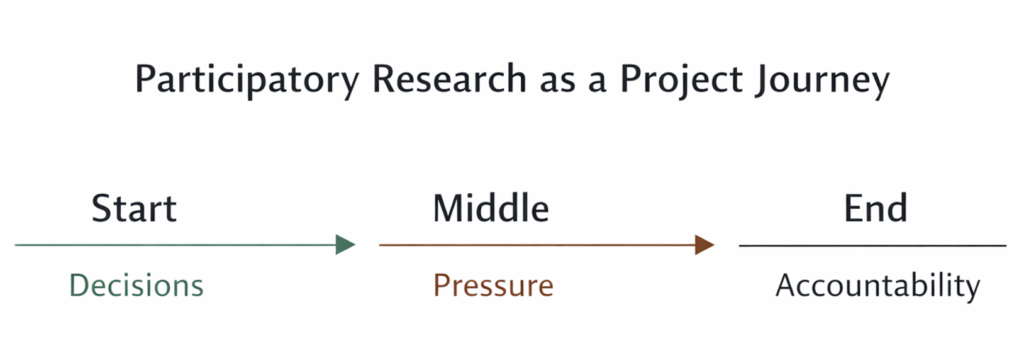
At the beginning of a project, many consequential decisions have already been made. Funding requirements, reporting structures, timelines and governance arrangements shape what participation can realistically influence. We examined who decides, who carries risk, and who lives with the consequences. These are rarely the same people. If participation is not designed with this in mind, it remains advisory rather than influential.
A central theme was overpromising. It is easy to use expansive language about co-design or shared decision-making. In practice, there are limits. Several participants noted that being clearer about those limits at the outset would prevent later frustration. Saying what participation will not change may be uncomfortable, but it avoids misunderstanding.
Short timelines also shaped discussion. When projects run for only a few months, there are limits to relationship-building and shared decision-making. Some forms of engagement are simply unrealistic. If key parameters are fixed, it is better to say so.
“Attendance is not engagement. Participation is measured by change”
Mid-project, different issues emerge. One discussion focused on the difference between attendance and engagement. Counting participants is straightforward; demonstrating influence is harder. We asked what evidence would remain if attendance figures disappeared from reports. In several cases, this prompted reflection on where participation had been substantive and where it had been thinner than intended.
We also discussed false consensus. Silence is often interpreted as agreement, particularly where hierarchies exist or disagreement carries social cost. Creating space for challenge without exposing participants to reputational or relational risk requires deliberate design.
Payment and recognition were part of this conversation. Time, emotional labour and reputational exposure are real contributions. Decisions about payment affect who can realistically afford to take part.
Although most of the workshop focused on project beginnings, we also addressed endings. As deadlines approach, communication shifts. Decisions about how findings are returned, how input is represented, and how success is described are often made at completion. We asked participants to identify one decision that changed because of participation and one that did not. This shifted attention from activity to consequence.
The discussion stayed close to practice rather than theory. We returned repeatedly to practical questions: who has influence, who carries risk, and what has actually changed.
If you are working with vulnerable communities or non-academic stakeholders and would like to reflect on how participation is structured, communicated or measured in your own projects, I would be glad to continue the conversation.